Wednesday, March 13, 2013

Reconstruction Plans

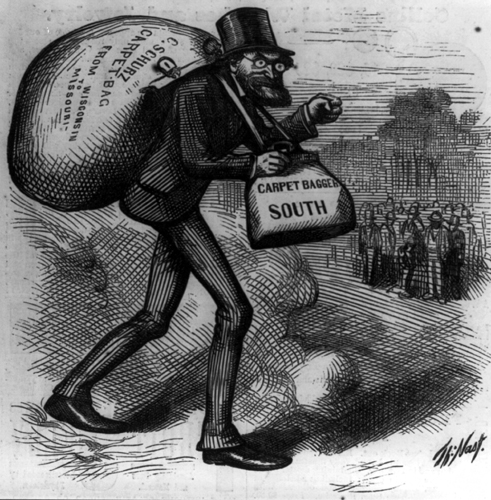
After the intense four long years of battle, the American Civil War was finally over. However, the cost for freedom was great and many lives were changed for the worst. The main disadvantage was that now the United States were split, divided between the north and the south. Another harm was that there were many African Americans that didn't know what to do with themselves now that they were free. To solve this, Lincoln started creating reconstruction plans in 1863. However, he was murdered in 1864, which made it a lot more difficult to carry them out. After his death, Johnson took charge as the 17th president of the United States and tried to continue with Lincoln's ideas. In 1865 he argued that their goals have been met, so there was no reason to advance in planning. The Congress did not agree with his position, so in 1866 they broke from him, and eventually got enough votes to revoke his vetoes. With this new power they implemented "Radical Reconstruction" in 1867. With this plan blacks began to receive opportunities to start lives for themselves; education, voting rights, jobs.


Thanks to these websites for making this blog possible:
  1. www.wikipedia.com
  2. www.georgiaencyclopedia.org
  3. www.legendsofamerica.com

Alexander H Stephens and Secession in GA


Alexander H. Stephens had a humongous impact of the secession of Georgia. In 1871, when the Georgia special convention was held to decide whether to secede, he was their governor. He was not for seceding, however his opinion was that if the government kept letting the north nullify the Fugitive Slave Act, then they should secede.
Stephens was also was apart of the Confederate Congress and elected Vice President of the Confederacy. While in office he did not voice his opinions about state's rights. Even though he was a supported of slavery, he still helped pass the Compromise of 1850. 
When Georgia elected him as their senate in 1866, the republicans were furious and proceeded to kick him out of office.   


Thanks to these websites for making this blog possible:
  1. www.georgiaencyclopedia.org
  2. www.wikipedia.org

Henry McNeal Turner

Henry McNeal Turner was a prominant African American leader during the Civil War. He held a prestigious position as the first black chaplain in the United States Colored Troops. He was also involved with the Freedman's Bureau. After he moved to Macon and was elected as the state legeslator. He was a bishop during his lifetime as well. As you can proably tell, Turner lived as a jack of all trades, until the Jiw Crow Laws were set. He, enfuriated by the laws, became an active supporter of black nationalism. Soon he was looked upon as the symbol of african americans' rights.


Thanks to these websites for making this blog possible:
  1. www.wikipedia.org
  2. www.theforgottenprophet.blogspot.com

Freedman's Bureau


 Freedman's Bureau was an organization that aided newly freed African Americans. The bill that created the Freedman's Bureau, Freedman's Bureau Bill, was passed by Abraham Lincoln in March 1865. It was intended to last only approximatly one year after the Civil War ended, just long enough to help get the freedmans in the south on their feet.

Their goals were to get African Americans jobs working with whites as equals, not as the dominants and the submissives. They wanted the blacks to be bank owners, or entrepeneurs, or business men. They wanted them to become people who added to the economie's success, in a way more than just picking cotton.
However, when a community has been one way for a while, it's hard to break their habits, but the Freedman's Bureau was dedicated. They expanded the time limit of the bill to ensure the freedmen were okay. Soon after, the Freedman's Bureau was doing much more than helping them to start businesses and to educate, it started a program to find their lost families. Imagine being seperated from your mother or father or sister and brothers for decades, and thanks to the help of this organization, you can finally be reunited.

 Even though their chains from slavery were broken, they weren't guarenteed a good life. The Freedman's Bureau was the push they needed to start their lives as free, independent African Americans.


Thanks to these websites for making this blog possible:
  1. www.wikipedia.org
  2. www.faculty.assumption.edu

Union Blockade of Georgia's Coast

   The Union Blockade, in general was a way for the union to block the trading of goods, weapons, and supplies for and from the confederates. It was implemented on April 19, 1861 by Abraham Lincoln. This plan required the control over twelve major ports; New Orleans, Louisiana, Alambama, Mobile, Richmond, Charleston, Savannah, Virginia, South Carolina, Georgia, Wilmington, and North Carolina. The reason why the blocking of Georgia was so important was because it was the home to Savannah, a prominant port city. This strategy was an essential part to the Union's victory in 1864.


Thanks to these websites for making this blog possible:
  1. www.georgiaencyclopedia.org
  2. www.wikipedia.org

Sherman's Atlanta Campaign/ March to the Sea

Atlanta Campaign

William T. Sherman

The Atlanta Campaign is not just one battle, but several. The reasons for these battles are both political and strategic. Since Sherman's troops had invaded most of Georgia, the confederates fled to Atlanta and made it their camp group. Sherman's plan was to block their line of supply; the rail center. That way the confederates had no way of getting the necessary items to survive, they had no choice but to surrender. With the surrender came glory and trust. During this time (1864) Lincoln was working to get his 2nd term in office. Since the citizens were sick of war and what came with it, Sherman's big win put their faith back in the hands of the union and most importantly Lincoln.

March to the Sea

Sherman's March to the Sea, also known as the Savannah Campaign, started on November 15 1864. It is notorious for being the cause of the most civilian destruction of the Civil War.
At this time, Sherman was desperate to put an end to the war, so he constructed a dangerous, irrational, illogical, and brilliant plan that would turn out to be the reason for the Union's win.
Sherman's goal was to capture the city of Atlanta, and the way he sought to do that was by going through and eradicating everything in sight. His troops destroyed industry, infrastructure, and civilian property. David J. Eicher says Sherman "defied military principles by operating deep within enemy territory and without lines of supply or communication. He destroyed much of the South's physical and psychological capacity to wage war." However, it was a necessary sacrifice to make, because in the next couple of months the Confederates finally surrendered.


Thanks to these websites for making this blog possible:
  1. www.georgiaencylopedia.org
  2. www.wikipedia.org
  3. www.wired.com

Tuesday, March 12, 2013

Sharecropping and Tenant Farming

Sharecropping

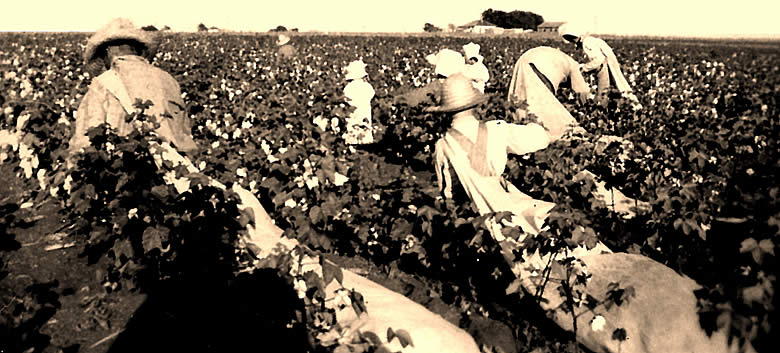
 During the Civil War Reconstruction era there were many farm owners who could not afford to keep their property running efficiently because of their lack in funds. Therefore they created a solution called "sharecropping". Sharecropping can be defined by looking at its name, the sharing of crops. An owner of a farm could allow a person to raise crops on their land. At the end of the year the farm owner would collect a portion of the profits.
The system of sharecropping seems simple and efficient, and in the beginning it was. However, overtime it became into a never-ending circle of debt. People quickly realized that sharecropping wasn't the best way to become independent individuals.
{Sharecroppers= people who could only offer their labor}

Tenant Farming

Tenant farming is similar to sharecropping. The difference is who the farm owner is working with. Sharecroppers are people who can only offer their labor and aren't very strict over what profit they get back.The tenant farmers however, were a lot more self-sufficient. They owned their own tools, supplies, and plow animals. They also would make sure to get more than half of the profits.


Thanks to these websites for making this blog possible:
  1. www.wikipedia.com
  2. www.georgiaencyclopedia.org
  3. www.texasbeyondhistory.net